Song of the City (part 1 of 2)
Song of the City is a contemporary fantasy featuring possession, a haunted object, and an unlikely narrator.
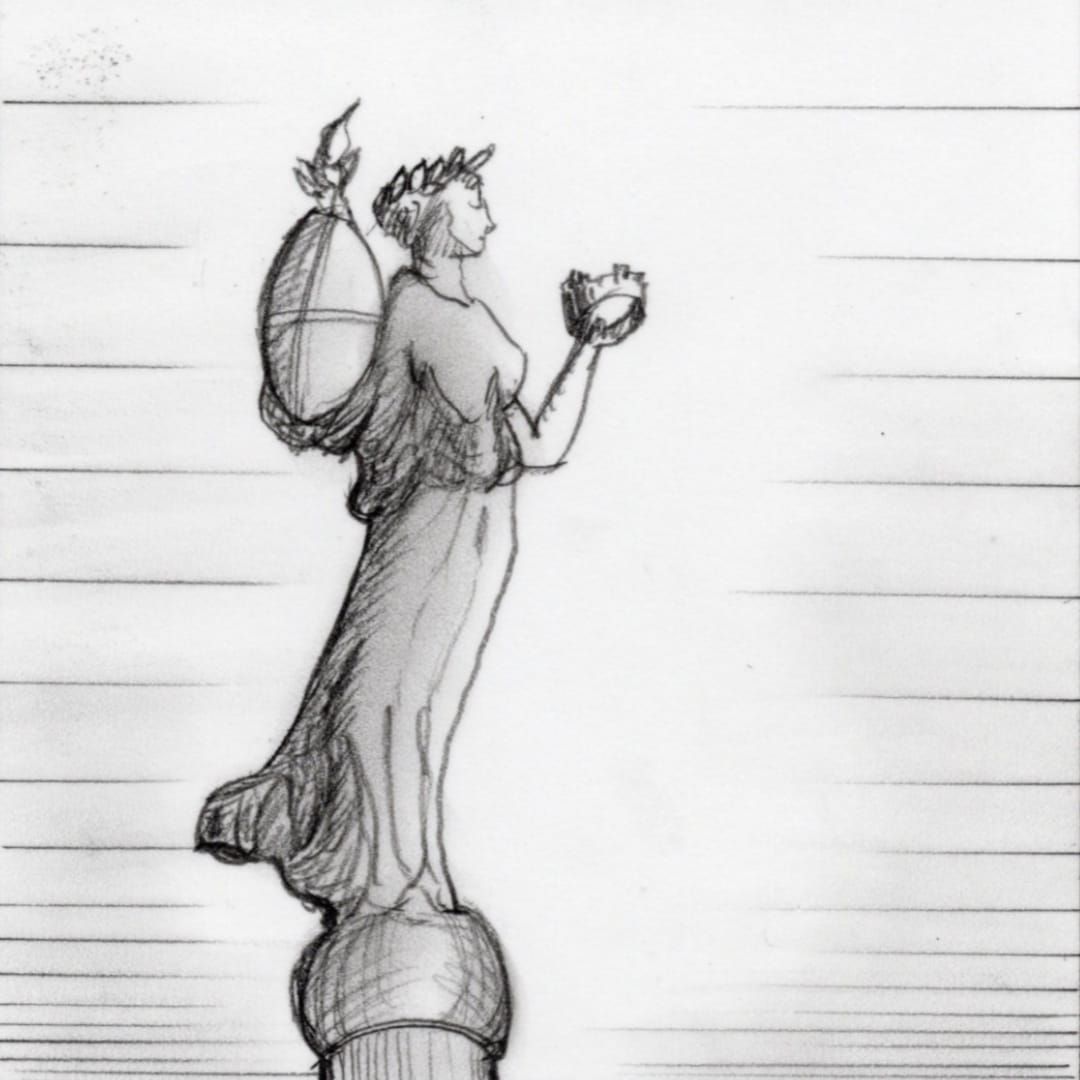
Where am I? This was not my state hospital room, with its barred windows and rough sheets over a lumpy mattress. My mother’s solution for my irrational life. I combed my memories. This was not my seedy first apartment on the East Side.
Was I in the sculptor’s drafty studio, blindfolded and strapped to a posing stand where I stood exposed to his measuring eyes for hours?
Impossible; I left that life decades ago.
I wanted to take a deep breath, but I didn’t need one.
Only vibrations—firm, soft, quick, and slow—described the world around me. My feet balanced on a dome that cupped sounds from a building below. Voices sounded in its stone-lined halls and wood-paneled offices, making the building hum like a beehive.
I reached further.
On the street level, an echoing portico crouched over a subway station that trembled with each train’s passage.
Was I back in the city? My touch followed the pulse of a train to the harbor, where the thrumming current pushed against straining chains and churning propellers.
More! I opened myself until my body shivered in the brassy cacophony.
I knew this sound; it was my city.
Do they remember me? I was famous once.
I narrowed my focus to the slow heartbeat of a sturgeon napping in the shadows of a humming bridge.
I was famous, but not lucky.
A clock tower pulsed four o’clock against my skin, then five, and six as the city finished another day. The sun released me from its heated embrace, and I straightened upward, clicking and groaning as my metal skin cooled. Dripping down from my memory, the clues accumulated, and when I remembered an architect’s drawing tossed in the corner of my sculptor’s studio, I knew who I’d become.
I’d awoken inside the golden statue they’d named Civic Fame. It had my face and body and was twenty-five feet tall. When they hoisted it to the top of the municipal building, I was twenty-two. That was so long ago. Last month, at the hospital, I had my 98th birthday.
The sunrise warmed my back and my legs, and the city started another day.
#
Deep, down in the hollows of granite-faced walls, Rat climbed. Her whiskers twitched with anticipation as she followed the irresistible fragrance of old paper and animal glue to a circular room at the top of a building. Piles of yellowed newspaper, Rat’s favorite nesting material, filled cardboard boxes sagging against the sides of dusty oak cabinets. She’d found the perfect spot. Driven by hormones and instinct, Rat had to make a safe space for her unborn pups. She chewed enthusiastically, cutting the newsprint into pieces for her nest.
Men arrived, stinking of sweat and tobacco. Rat hid under a cheese-stained paper plate. Through her whiskers, she felt their bodies setting down on the chairs. Rat wanted to scrabble back into the walls, but if they saw her movement, they’d chase and try to stomp on her. Their words, so low and slow in her ears, made her grind her back teeth for comfort, but if she slowed her mind to listen, she caught the meaning.
“Welcome to the cupola, Mr. Mayor.”
“Lenny, you're a hoarder. Know that?” The volume diminished as the man walked away from Rat. She allowed her ribs to expand for another breath. “Why do you keep all this old stuff?”
The other stood, and Rat tensed, anticipating a stomping foot, but the shoes moved off.
“Excuse me? These are documents about our city’s rare ornament. You know about her, don't you? ” said Lenny.
“Who is that?”
“Her.” Rat felt Lenny’s voice bounce off the ceiling as he lifted his chin.
“City something? What's her name? City Pride?” asked the mayor.
“Civic Fame.”
“Ah, yes. That’s it. Lenny, did you know the model for that sculpture had an understanding with my grandfather when he was mayor?”
Both sets of feet stopped moving, and Rat tensed. Had they spotted her?
“So your grandpa had a side piece. Who cares? Different times,” said Lenny.
“My great aunt always brings it up at Thanksgiving.”
“Granted, it's a family thorn, but what are you going to do about her statue, Mr. Mayor? She's falling apart up there.”
“We'll decide after the election—if I get another term.”
The feet moved, and Rat compressed herself into invisibility. Crumbs of plaster hit the floor nearby, but she didn’t scurry for the nearest hole. They departed, and the door banged against its frame as the lock slid home. Later on, in a corner wastebasket, Rat found a wilted scrap of lettuce stuck to a sandwich wrapper. She ate and searched for the place to build her nest.
#
Several people arrived on my cupola with the slam of a windblown door and determined footsteps. Curious, I loosened my metal plates to feel the vibrations of their words. My torso and skirt plates were too large to resonate cleanly, but the small plates that made my hands worked fine. I tuned the tension across my knuckles to resonate with their words. Their voices sounded tinny, like they were speaking inside a water tank. There were two voices—a rich baritone and a nasal tenor.
“She was the face of the Gilded Age, but even immortal icons need maintenance now and then,” said the tenor.
“These days, the budget doesn’t have much love for this old gal, Lenny,” said the baritone. “She looks bad.”
Old gal? My back plates stiffened at his comment.
“She’s been here since your grandfather was mayor. He commissioned this statue.”
I hummed with surprise and remembered elegant hands, ornamented with diamond cufflinks, opening the front of my evening cape. That was so long ago.
“Mr. Mayor, did you hear something?”
“No. What do you mean?”
“She's humming, sir.”
“Humming? Must be the wind,” said the mayor. “Let’s go.”
“But, sir. What should…”
The wind blew Lenny’s question away as they left. I was elated. I’d finally met my grandson. Might I get him to hear my voice?
#
Rat dragged a crust out of the wastebasket, ate it, and continued her search for a nesting place. Following a narrow vent, Rat emerged on a roof. Her whiskers brushed the ribbed stone block as she explored. The soft fur on her back bent under a puff of wind. She'd felt that before—in the tunnels—but there were no engines and wheels to avoid in this space. Sunlight warmed her ears, but she shivered because she was exposed to the sky. Rat darted for the nearest shadow. The beaks and claws that came down from above—sudden death on silent wings—lived here, in the sky.
Against a stone plinth, Rat discovered a pile of windblown trash. She burrowed deep under the soggy papers and leaves and found an odd metal wall. Its rusty parts sagged open at one of the seams, providing access. She wiggled through the gap and into another space, climbed its internal framework, and found the perfect place for her nest.
#
A rat had nested inside my left foot. I remembered hiding from rats in a padded room at the state hospital. The canvas jacket protected my arms.
That was so long ago.
To scare my foot rat away, I used the wind to push my shin plates into a screeching racket, but she wouldn’t leave. Maybe she liked it. Maybe it sounded like the subway to her.
I'd had no visitors for weeks. More of my gold leaf flaked off every day, and while that loss let my plates vibrate more freely, it also exposed the welds. Day by day, my appearance degraded. We were well into autumn when I noticed the growing weakness in my left arm. I had to act, or the unrelenting hum of the city and the winds would break me. I tried to stiffen my structure, but only counter-humming dampened the destructive vibrations. My arm stayed put. I found a measure of triumph in that discovery. But my small victory did not last.
#
Rat pushed a large wad of newspaper shreds into the vent. The door opened, the lights flared, and a man entered the cupola. Blocked from escape, Rat whipped behind a stack of boxes to hide. The man reeked of anger, and the stomping feet slipped and stumbled as he crossed and recrossed the room.
“There's nothing for it. I'll lose half my voters if I scrap that damned statue.”
Rat huddled inside a shadow, motionless as her heart hammered.
The stomping paused for a moment, and with a sudden thunder, three boxes tumbled across the floor, spilling old clippings and yellowed photos.
“I should fire Lenny for this mess.”
The pacing resumed. Rat touched the wall with her whiskers—she knew another man was coming up the stairs. The lights in the cupola went off. Rat ground her teeth with anxiety when the door slammed open on the balcony—she couldn’t protect her nest.
#
The mayor had returned to visit me. I stopped my perpetual hum, and one of my knee plates sagged open.
“Hello? It's me, Mayor Price.” His feet shuffled along the balcony as he muttered.
“Why am I talking to a statue?”
I rippled my skirt parts with a chiming glissando and tightened my knuckle plates to listen.
“Are you humming, or is it the wind?”
When he spoke again, I tried to make the sounds of words with my knuckles.
“G-r-r-a-a-a…”
The mayor sidled along the balcony and banged against the railing.
“My grandfather knew you when he was mayor.”
If there was a time to speak, it was now. I had to try again.
But what should I say? That I loved his grandfather? That he loved me? That he took our baby as his own and bought my silence?
I tried again, chopping the hum into word-sized bursts.
“G-r-r-a-a,” I said.
“Damn mosquitoes. How did they get up here?” The mayor slapped his neck.
I dropped my pitch and tried again. My voice echoed off the buildings across the street. The balcony shook from the mayor’s feet as he paced.
“Is anyone up here?” The mayor sounded annoyed. “Lenny, that’s not funny.”
I tried again. “G-r-r-a-a-n-n—s-s-s-o-o-n-n.”
His shoes squeaked as he stopped.
I refocused and carefully enunciated. “Grandson.”
The mayor was motionless. His voice pitched higher when he spoke again. The balcony door creaked.
“Na-na? Is that you? How is this happening?”
I was about to reply when Lenny’s voice called from the open door.
“Mr. Mayor? They’re waiting for you.”
His silence lengthened, and then the mayor said, “I’m coming, Lenny.”
He turned with a squeak of shoe leather and walked away, just as his grandfather had seventy years ago.
Song of the City (part 1)
Song of the City is a contemporary fantasy featuring possession, a haunted object, and an unlikely narrator. It follows the experiences of a woman who wakes inside the statue she modeled for in decades past with no memory of how she got there, and Rat, who's looking for somewhere safe to live and raise her pups.
Ann Cudworth (also writing as A. C. Worth) is the author of short fiction in Metaphorosis Magazine, Exterus, and Sci-Fi Lampoon, and the anthologies Score—An SFF Anthology, Radicle, and Sages of Metaphorosis. She writes science fiction and urban fantasy, shaped by workshops at Odyssey Writing Workshop and the Sarah Lawrence Writing Institute, as well as Futurescapes and the Juniper Writing Institute.
Copyright 2026 Ann Cudworth. All rights reserved.
Read more at https://www.acworthwriter.com/
My stories are written by hand and edited with ProWritingAid.